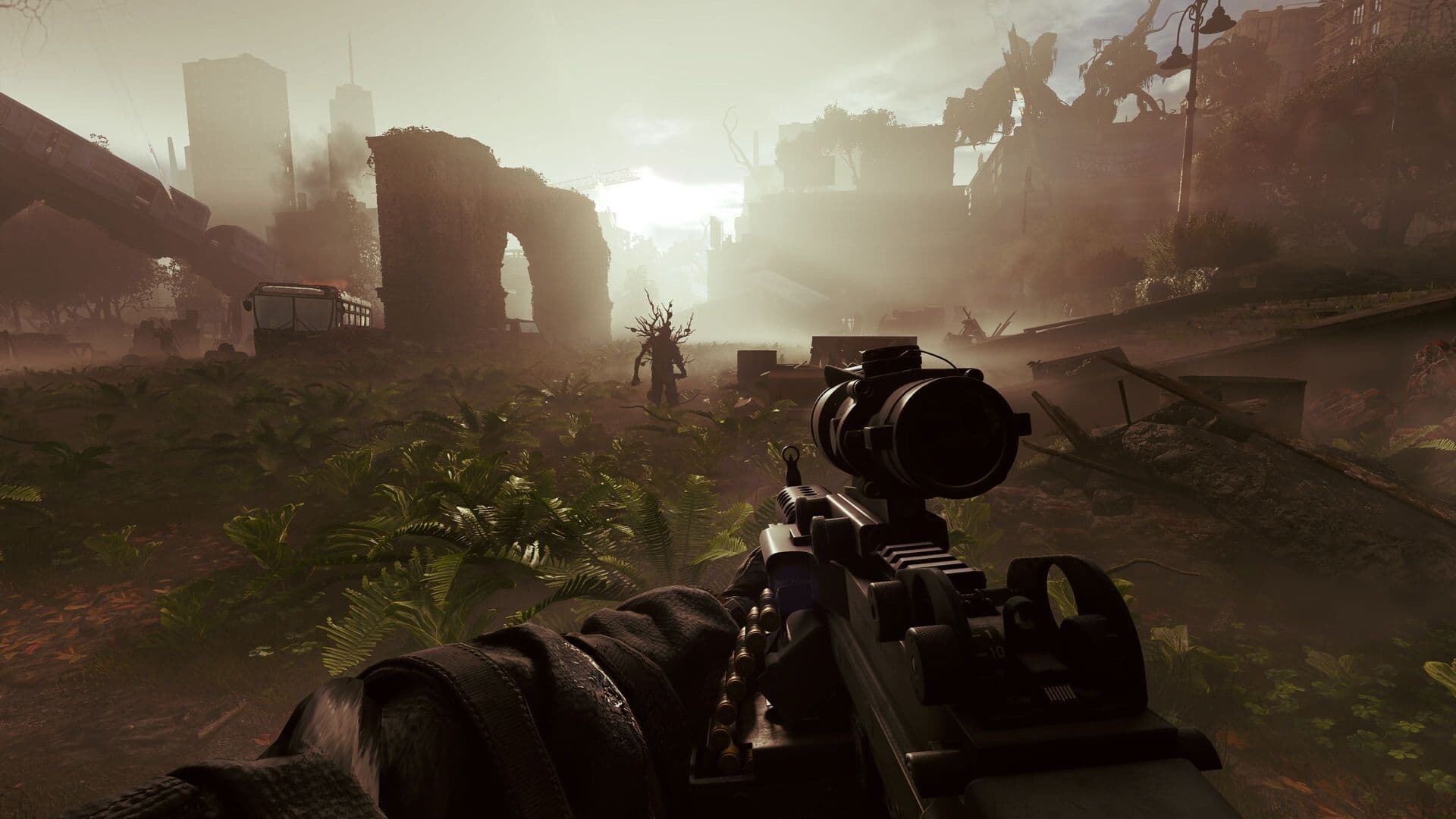
Active Matter is Tarkov's loop with different rules underneath. You deploy with what you're wearing, loot, extract or lose it, and everything outside a small container stays in the zone when you die. The guns are the ones you know: M4A1, MP5, SPAS-12, M24, SV-98, PKM.
Then the rules diverge, and they diverge in the places that cost a Tarkov player the most: squads are three, PvE is a toggle on every raid rather than a separate profile, there is no flea market, wipes are yours to trigger, and the inventory has no grid. Here is every system you know, and what it became. Checked in the game on builds 0.4.0.148 and 0.4.0.156 (25 and 27 September 2026).
The translation table
| Tarkov | Active Matter | What changes |
|---|---|---|
| Raid (PvP) | Open Raid | Same idea, but Open raids run on a schedule and the map list rotates |
| PvE mode / offline raid | Isolated Raid (PvE) tab | A toggle on every raid, on the same profile, with full progression |
| Five-man squad | Three operatives | Two seats beside you, not four |
| Secure container | Safe container | Bought with starting currency, not tied to your edition; one oversized item allowed |
| Seven body parts | Six health pools | No stomach; hands and legs have their own bars, plates slot by body part |
| Grid inventory | Volume budgets | No Tetris: rig, backpack and container are numbers |
| Roubles | Credits (₳) | The everyday currency, from the Refiner |
| Trader levels and hideout | The Monolith | Twelve Greek-lettered levels; gates are extractions from named maps |
| Flea market | Nothing | No player trading at all; the Shop has fixed prices |
| Hideout crafting | Replicator | Blueprints with limited runs, or unlimited fusion for chronotraces |
| Skills | Chronogenes | Four slots, three tiers, and death burns charges off them |
| Quests | Cases and objectives | Three cases at once, dailies that reset, two tiers that need Open raids |
| Scavs | Turned Soldiers | Armed human AI, plus creatures and anomalies Tarkov has no version of |
| Scav run | Rented equipment | Still your own operative, in borrowed kit picked at the Loadout check, and you keep what you extract |
| Wipe | Personal Timeline and Harmonization | You wipe yourself; the community can wipe everyone |
| Arena | Hired Ops | Team PvP with issued gear, no extraction rules |
Raids: the PvE toggle you always wanted
Every raid on the Missions Terminal has two tabs: Isolated Raid (PvE) and Open Raid. Isolated is what Tarkov's offline mode never was. Hover it and the game says: "Only you (or your group) can enter the raid. No interference from other players. Contracts and quests can be completed as usual."
Same character, same stash, same progression. There is no separate PvE profile to buy or level. Isolated raids are also always open: Gaijin's developer Q&A says "All existing Isolated Raids, including their variants, can be played anytime." Thirteen of the nineteen raids offer it; the five that don't are Open-only by design. The full list is in our PvE-only guide.
Open raids are the Tarkov you know, with two differences. They run on a schedule: an hourglass beside the crossed swords means the raid is live, a circular arrow means it's closed and when it's back. And the map list rotates, with variants attached (Shegolskoe: Distortion, Cargo Port: Darkness, Factory: Hive). The suffix changes the raid, so read it.
One thing Tarkov never gave you: a Solo matchmaking setting on Open raids that matches you against other solos only. Our solo guide covers it, and the Auto-fill toggle next to it.
Your secure container is a safe container, and you buy it
Tarkov ties the container to your edition. Active Matter sells it. The Shop's Special tab lists Small, Medium and Large safe containers at Ȼ50, Ȼ100 and Ȼ200 of Crystallised Active Matter, and a Standard Edition account starts with Ȼ300. It's the first purchase on any account, and no edition skips the step.
The description carries a rule Tarkov doesn't have: "Allows volume overflow with a single item." The container has a volume, but one item can exceed it, so a single big find fits even when it shouldn't.
Death is otherwise the death you know. Everything outside the container stays in the zone, and there's no insurance we've found. When you'd rather not risk your own kit at all, pick Rented equipment at the Loadout check instead. Save a gear set and a death becomes one click and a known number: our test Vepr kit's missing pieces came to ₳4,840.
Health, armour and the end of inventory Tetris
Tarkov splits you into seven parts. Active Matter uses six: Head 100, Torso 220, each hand 130, each leg 165. No stomach. Each part takes damage on its own, the way you're used to.
Armour is plates by body part, in sizes S, L and XL, with their own hit points (a fresh torso plate reads 340/340). Which parts can take a plate at all depends on your Body Sleeve, a layer Tarkov doesn't have: it sets your plate layout, your base inventory volume and a set of passive modifiers. The Deluxe edition's Reaper, for example, has a Large torso slot and Small slots on both hands and legs. Every sleeve is in our Body Sleeves guide.
Inventory is volume, not a grid. Your rig, backpack and container are numbers, every item has a volume, and the sleeve changes how much space ammunition, medicine and grenades take. Nothing rotates, nothing has to fit a shape. It's the change you'll notice first and stop thinking about fastest.
Money: no traders, no flea, one Refiner
Tarkov's economy is traders plus the flea market. Active Matter's is a Shop with fixed Credit prices and a Refiner that turns loot into money. There is no flea market and no player trading of any kind, which is also why nobody sells Active Matter currency.
The Refiner is where "what's this worth" gets answered. Queue what you extracted, and the Expected result panel prices it in Credits, Active Matter units and typed chronotraces before you commit. Hover any item in your stash and the tooltip shows its expected refine result, so you know before you carry it.
The currencies map like this:
- Credits (₳) are roubles: the everyday currency, and the Refiner's main output.
- Monolith Tokens buy Monolith nodes. Closest Tarkov equivalent is trader reputation, except it's a currency you spend.
- Crystallised Active Matter (Ȼ) is the one-time-grant currency: it buys the container and beacons, and converts (Ȼ100 into ₳10,000, Ȼ500 into 5,000 tokens).
- Chronotraces are typed crafting components with their own storage. They feed the Replicator.
- Merits are the seasonal currency, earned from Monolith levels and Priority Raid objectives.
The currencies guide has every way each is earned and what a reset does to it.
The Monolith is trader levels, hideout and quest gates in one ladder
Twelve access levels, named with Greek letters: α β γ δ ε ζ η θ ι κ λ μ. Each has an Access upgrade gate and, behind it, nodes bought with Monolith Tokens: raid access, Replicator recipes, case unlocks and shop unlocks.
The gates are the part a Tarkov player should read twice. They're requirements, not prices. Beta asks for Alpha, a tokens-spent threshold, and one successful extraction as an operative on each of Shegolskoe, Factory and Airport. Nothing in the Shop skips that. Think of it as every "survive and extract from X" quest in Tarkov, made mandatory and stacked into a ladder.
Shop unlocks are labelled "Unlock & Replication": one purchase puts the item in the Shop and hands you its blueprint. The good guns sit behind nodes you can't buy yet, at five to twenty times the starter prices, so "should I save for the AA-12" answers itself for the first week.
Hideout becomes Shelter, crafting becomes the Replicator
Your Shelter is the hideout: the Missions Terminal, Shop, Refiner, Replicator, Monolith and Investigations Terminal are its rooms. It has building and decorations, and the daily loop starts and ends in it.
The Replicator prints blueprints. Each blueprint has a limited number of replications and each run takes time in a module, which will feel like a hideout craft. Blueprints come from Monolith nodes, or from extracting an enriched copy of the item: enriched items are the ones that came out of the zone changed, and bringing one home teaches the Replicator. That's as close as the game gets to Found in Raid. Fusion is the unlimited, instant version, paid in chronotraces. Replicated items sell back for a single Credit, so you print things to use, never to flip.
The workshop guide has the real refine payouts and fusion costs.
Skills are chronogenes, and dying burns them
Tarkov skills level with use and never go away. Active Matter's chronogenes are equipped: four slots on the operative, each holding one at Tier I, II or III. Melee, Breath Control, Heal Efficiency, Active Matter Gathering, Speed, Steady Hand and more.
Tier III chronogenes carry charges, and death burns them. Push a gene past its limit and it reads Overunstable, and burns faster. New chronogenes come from Replicator recipes, including a Tier III random synthesis that costs Active Matter and three Tier II genes. There's also a separate Perks Tree of passives tied to your current Personal Timeline. The Characteristics and Skill screen stacks sleeve, genes and tree into one Modified Stats list, which is the number the game actually uses.
Quests are Cases, plus dailies
Cases live in the Investigations Terminal and are the story spine: chains of tasks tied to specific raids, with a reward strip and a briefing. You can run three at a time, and the terminal filters them by the raid you're about to deploy to, so check it before every deploy.
Two objective systems run alongside. Primary Objectives reset daily: Active Matter Collection, Priority Raid, Baseline Compliance, and two tiers (Qualified Field Work, High-Value Operations) that only count in Open raids. Operative Objectives are a rotating set of five per raid. Both pay Credits and tokens. No Kappa, no trader rep grind, no quest that needs a specific key.
Scavs are Turned Soldiers, and then it stops being Tarkov
Turned Soldiers are the armed human AI, and they shoot back the way Scavs do. You never play as one: every entry into a zone is your own operative. What replaces the Scav run is Rented equipment, which you pick at the Loadout check before you deploy: borrowed kit, so your own stays safe. Whatever you extract with it is yours to keep, just like a Scav run's haul.
Everything else on the pre-deploy map's icon strip has no Tarkov equivalent: Distorted, Invisible, Hellhounds, Flowermen, Dendroids, and on Gigastructure, Mimics. Anomalies bend light and gravity and are visible at a distance; treat them as a route problem, not a fight. The most-replied thread on the Steam forums is a request to reduce the monsters, which tells you the density. Since update 0.4.0.156 the big ones at least pay: 3 to 4 times from Shy Girls and about 10 times from Alpha Mimics and Alpha Flowermen.
Extraction points are the green running figure on the pre-deploy map, every raid has a timer, and the last five minutes are where people die. Some raids replace the exit entirely: the Unstable Zones are Survive raids where you outlast a collapsing zone and leave through a portal when it opens.
Wipes: you hold the button
Tarkov wipes everyone, on BSG's schedule. Active Matter's FAQ says there was no wipe planned at release, and that "regular self-wiping is a key part of the game through player-driven decisions." That's the Personal Timeline: you choose to start a new one, and since 0.4.0.156 your equipped gear waits in a temporary stash while you do. The Perks Tree belongs to the current timeline.
Above that sits Harmonization, a meter in the top bar (21.7% on our account on 27 September). The FAQ describes a community-wide wipe, "harmonization of the multiverse," that preserves prestige and edition bonuses. Merits earned along the way spend in the Fundamental Protocol, which unlocks at Monolith Delta and, since the 24 September patch, works whether or not a cycle is running.
The short version for a Tarkov player: nobody resets you but you, and the reset keeps more than you'd expect.
Squads are three, and the third seat is the hard part
Tarkov's five-man is Active Matter's three, and the game is tuned for it. Auto-fill will hand you two strangers on Open raids; Isolated raids give you nobody you didn't invite. The problem on week one isn't the systems above. It's having two people online when you are who already know where the extraction is.
If you'd rather fill a seat with someone who does, that's what our Squad Carry below is: a pro on their own account, in your squad, Isolated or Open, for the hours you book. Stated once, because it's true of every paid service in this game: Gaijin's EULA (§3.2.6) bans paid "combat services," so this is against the rules. What it avoids is account sharing, because nobody logs in as you. The full reasoning is in Active Matter Boosting Explained.
Tarkov player questions
Is there a flea market? No, and no player trading of any kind. The Shop has fixed prices and the Refiner turns loot into Credits.
Is there insurance or a Scav run? No insurance: the safe container is the only thing that comes home from a death, which is why it's the first purchase on any account. There's no Scav character either, but you can pick Rented equipment at the Loadout check and deploy your own operative in borrowed kit, and you keep whatever you extract.
Does it wipe? Only when you choose to, via a new Personal Timeline, or when the community triggers Harmonization. There's no scheduled global wipe.
Is the PvE mode a separate account? No. Isolated Raid (PvE) is a tab on every raid, on your normal profile, with full progression. Thirteen of the nineteen raids have it.