
Almost everything you bring home in Active Matter ends up in one of three places: the Refiner, which breaks it down; the Replicator, which builds new things out of what the Refiner gives you; or your four chronogene slots, which the Replicator also supplies. They're one economy, and the game explains very little of it. This guide goes through all three, from the numbers on the screen.
It's written from the game, not the wiki. Screens are from build 0.4.0.148, 25 September 2026.
The loop in one line
Loot goes into the Refiner and comes out as Credits, Active Matter and chronotraces. Chronotraces go into the Replicator and come out as gear, and as chronogenes. Everything below is detail on one of those two steps.
The Refiner
Open Workshop, then the Refiner tab. Drag items from your stash into Items to refine, and the Expected result panel totals up what you'll get back before you commit. Press Start refining and it pays out on the spot.
Two things the screen tells you in red and most people miss:
- Anything left in the Refiner is refined automatically when your next raid starts. Don't park something there you meant to keep.
- You don't have to open the Workshop at all. Inventory has a Quick Refine panel beside your stash: drop an item in, press Complete refine, collect.
What it pays out
Three kinds of thing:
- Credits, the everyday currency.
- Active Matter, from some items only. In our tests two enriched items paid it; nothing ordinary did.
- Chronotraces, in six types: Metal, Composite, Energy, Fiber, Chemicals and Idea. They go into their own Chronotrace Storage (50,000 on our account), separate from your normal stash, so refining never fills your inventory.
Read the tooltip before you refine anything
Hover any item and its tooltip ends with Expected refine result and a Total value. That total is the game's own valuation of the whole payout in Credits, chronotraces included. What we saw:
| Item | Rarity | Refines into | Total value |
|---|---|---|---|
| AKM, with 5 attachments | Common | 904 Credits, 45 to 55 Composite, 4 Energy, 130 to 138 Metal | ₳1,844 |
| AN-94 Abakan (enriched) | Rare | 1,754 Credits, 8 Active Matter, 67 to 72 Composite, and 2 more | ₳5,011 each |
| Fine Parasaurolophus Figurine (enriched) | Rare | 150 Credits, 20 Active Matter, 304 to 312 Idea | ₳5,230 |
| Big first aid kit | Rare | 340 Credits, 9 Fiber, 61 to 65 Chemicals | ₳700 each |
| Burst injector | Uncommon | 90 Credits, 12 to 14 Chemicals | ₳155 |
| Dendroid remains (enriched) | Uncommon | 40 Credits | ₳40 each |
Three lessons in that table:
- Attachments refine with the gun. The AKM's payout includes its suppressor, scope, grip and magazine. Strip anything you want to keep first.
- Small civilian items can be worth more than rifles. A toy dinosaur weighing 0.05 refines for more than a rare assault rifle, and it's almost all Idea chronotrace, which several fusion recipes need in bulk.
- Some things are worth nothing refined. Dendroid remains pay 40 Credits, because they aren't scrap: the tooltip calls them a component for fusing chronogenes. Remains from creatures belong in the Replicator, not the Refiner.
Chronotraces themselves are worth ₳5 each if you refine them, so there's never a reason to.
The Replicator
The Replicator tab is a grid of blueprints, sorted by the icons down the left edge: weapons, attachments, armour and gear, medicine and grenades, and a set of chronogene recipes at the end. Each blueprint has up to two modes, shown as two small icons above it. Click the icons in the detail panel to switch.
Replication: limited, slow, cheap
Replication makes copies from a blueprint you own, and each blueprint only has so many. What we saw:
| Blueprint | Replications | Time per copy |
|---|---|---|
| AEK-971 | 5 | 12h |
| AR416A5 | 3 | 18h |
| Modern Large Backpack | 3 | 4h |
Run a blueprint down to zero and it shows a Depletion restoration cost: pay it (the wrench button) and the replications come back. For the AEK-971 that was 223 Active Matter, 663 Composite and 195 Metal chronotrace; for the Modern Large Backpack, 99 Active Matter, 53 Composite and 345 Fiber. The 14 September update cut fusion and restoration costs for rare items.
Replication jobs run in modules, the grid of slots under the detail panel. Our account had eight open and the rest locked, and the game's hint is to start each job in the fastest module. Claim all collects finished jobs.
Fusion: unlimited and instant, if you have the chronotraces
Fusion is the mode that matters. Replications left: ∞. Replication time: Instant. You pay in chronotraces, and sometimes a base item, and the result is in your stash immediately.
- TA31 Scope 4.0x: 125 Composite and 41 Metal.
- F-1 grenade: 19 Chemicals each.
- M9 Tactical: an M9 pistol plus 16 Composite, 15 Idea and 163 Metal. Fusion upgrades the base gun.
- AR416A5: an M4A1 plus 269 Composite, 270 Idea and 812 Metal.
- Modern Large Backpack: 35 Composite, 230 Fiber and 66 Idea.
Press Start fusion and a Required components window moves the chronotraces from your storage into the Replicator (which holds 9,999). For anything stackable, a Fusion runs slider lets you make as many as you can afford in one go: with 608 Chemicals, it offered up to 32 F-1 grenades.
If you're short, the game says exactly what's missing ("Not enough components: Fiber chronotrace x343"). That's your shopping list for the next raid, and the Refiner table above tells you which loot to bring back for it.
Replicated items sell back to the shop for 1 Credit. You fuse gear to use it, never to sell it.
Chronogenes
Chronogenes are the four slots beside your operative on the Characteristics screen: passive bonuses you can swap between raids. Click a slot to open the Chronogenes list, which shows everything you own at the top and everything you've seen but don't have, padlocked, below.
Tiers
The same chronogene comes in up to three tiers. Tier III is Rare and much stronger than Tier I. From the tooltips:
- Melee III: melee strength +40%
- Heal Efficiency III: healing effectiveness +40%
- Steady Hand III: hand stamina drain −35%
- Overflow Healing III: additional healing for all body parts +20%
- Breath Control III: hold breath while aiming +3.0s
The full list we saw includes Active Matter Gathering, Breath Control, Carrying Capacity, Cold-blooded, Endurance, Examination, Fire Resistance, Jump, Pain Shock, Serenity, Speed, Sprint and Steady Hand, plus locked ones with no tier numbers: Active Matter Locator, Berserk, Sharp Memory, Soft Steps, Tenacity, Trap Sense and Weapon Expert.
Charges: what dying costs you
A Tier III chronogene has charges, 10 when full. The tooltip is exact about the rest:
- Dying burns charges.
- "At 0 charges becomes Melee II." An empty Tier III isn't lost; it drops a tier.
- "Only one chronogene of this type can be owned at a time."
You can go over 10. Our Breath Control III showed 11/10, marked Overunstable in red, with "Charges burned on death: 1-2". An overcharged chronogene burns faster when you die.
Where new chronogenes come from
From the Replicator. The last page of blueprints is chronogene recipes:
- Chronogenes (from Distorted, Flowerman, Hellhound, Invisible, Scorch, Shy Girl or Turned Soldier), and Rare Chronogenes from Altered Wax, Dendroid, Devourer, Scorch and Shy Girl. These are why creature remains are worth carrying home, and why the Refiner values them at almost nothing.
- Tier II Random Chronogene and Tier III Random Chronogene.
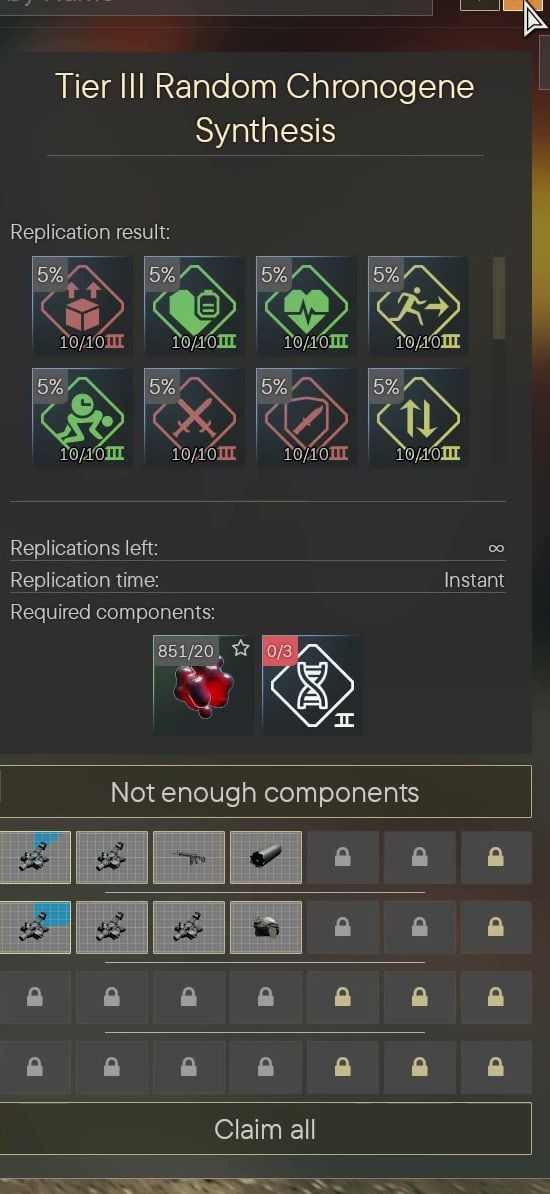
Tier III Random Chronogene Synthesis costs 20 Active Matter and 3 Tier II Random Chronogenes, is instant, and gives you a random Tier III at full 10/10 charges. Every outcome on the list we saw was 5%.
The Perks Tree is something else
Easy to confuse, because the names overlap: the Perks Tree (Profile, then Personnel Archive, then Perks Tree) is not where chronogenes come from. The game calls it an "experimental Agency Gamification program": you gain experience in raids, level up, and pick permanent passives from a radial tree. They're small, Common and always on:
- Melee I: melee strength +5%
- Heal Efficiency I: healing effectiveness +10%
- Active Matter Gathering I: +5%
- Carrying Capacity I: weight penalty reduction +3%
- Safe Fall I: fall damage resistance +3%
- Steady Hand I: hand stamina drain −5%
- Cold-Blooded I: body temperature −5%
- Pain Suppression I: shock time −0.5s
A few nodes further out are Rare (Serenity II is +5% stamina restoration and +5% pulse relaxation, against Serenity I's +1%). Some can be taken twice. They show up as Passive Effects under your four chronogene slots.
Where it all adds up
The Characteristics and Skill panel, on the Body Sleeve screen, stacks your sleeve, your four chronogenes and your Perks Tree passives into one Modified Stats list. It's the only place you can see the real number, and the numbers don't always simply add up:
- Healing effectiveness does add: Heal Efficiency III (+40%) plus Heal Efficiency I from the tree (+10%) reads +50%.
- Melee strength doesn't: a Reaper sleeve (+50%), Melee III (+40%) and Melee I taken twice read +87.5%, not +100%.
Check it after every change. Our Body Sleeves guide has every sleeve's own modifiers to start from.
What to do with this
- Hover before you refine. The tooltip's Total value is free information.
- Strip attachments you want to keep before a gun goes in.
- Keep creature remains. They're chronogene material, not scrap.
- Fuse, don't replicate, when you can. Instant and unlimited beats 18 hours for three copies.
- Let the "Not enough components" message plan your raid. It names the chronotrace and the amount.
- Don't die overcharged if you can help it. An 11/10 chronogene burns faster.
For where the currencies come from in the first place, see Active Matter's Four Currencies Explained. If the bottleneck is getting remains and enriched items out of a raid alive, a pro in your squad helps with that: our Squad Carry books one by the hour, and whatever you extract is yours.